



News
“Somebody’s got to do it. Why not me?”
Through leadership roles in ROTC and Camp Kesem, plus navigating an academic pivot, senior Andrew Voelsing has learned to face new challenges with enthusiasm.
MIT News |
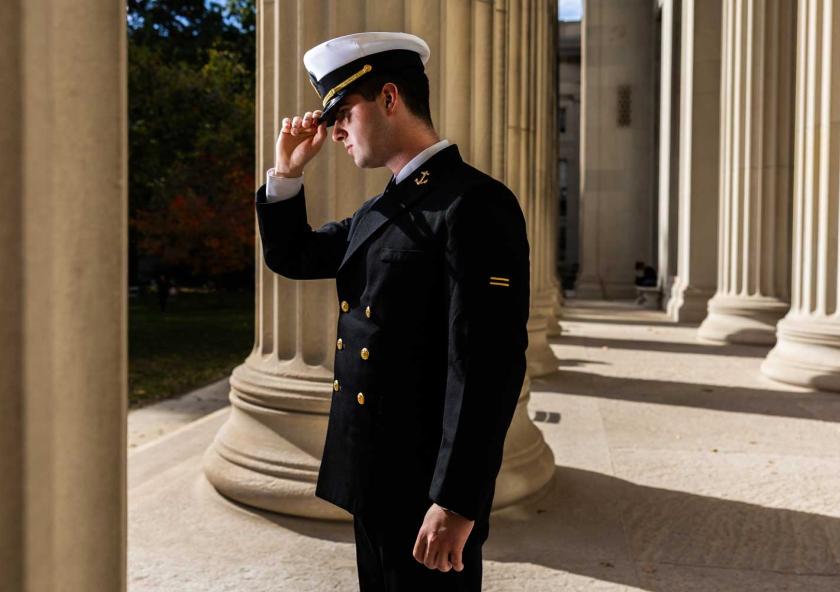
When Andrew Voelsing was 8 years old, he decided he was going to MIT.
He was fascinated by space and dreamed of building spaceships. The Institute, and its well-known aerospace engineering program, seemed like the obvious destination.
Years later, as a senior studying climate system science and engineering, Voelsing is preparing for a different kind of career: serving as a Navy officer, using his technical training to help the armed forces understand the ocean and atmosphere.
Even during childhood, military service was never far from his mind. His mother attended the U.S. Naval Academy, and his father participated in the Reserve Officers’ Training Corps (ROTC) at the University of Notre Dame. The two met while serving in the Navy in Japan. Growing up, Voelsing heard their stories about military life and saw how their experiences as naval officers shaped their lives.
Voelsing was eventually accepted to the Naval Academy himself. But he chose MIT for the variety of faculty and activities he could pursue while also earning his commission as a Navy officer through the NROTC program. He will soon assume the highest-ranking student role of Battalion Commander, responsible for NROTC across Greater Boston.
But the path from an 8-year-old’s dream to his senior year in Cambridge, Massachusetts, was not quite as straightforward as he had imagined. After arriving at MIT, Voelsing struggled to find his footing academically.
“I thought I was smart in high school. I thought I was at the top of my class, and then I got here and I was failing midterms,” he says. “All my friends seemed to be getting things faster than I was, and I just felt really out of place.”
During the winter break of his first year, he talked with his father about how he was feeling. His father encouraged him to find something that combined what he was good at, what fulfilled him, and what the world needed.
The conversation helped Voelsing reconsider his academic path. He switched from aerospace engineering to climate system science and engineering (Course 1-12), a then-new major offered jointly by the departments of Civil and Environmental Engineering and of Earth, Atmospheric and Planetary Sciences, and returned to campus feeling energized by his studies.
The change also helped him see how his education could serve a purpose beyond earning a degree. As he continued his ROTC training, he began to consider how technical knowledge about the environment could inform decisions with real-world significance.
The change, he says, was like night and day.
“I really figured out how to study,” he says. “Finding out my own vision of self and academic fulfillment helped me propel myself forward.”
A course in environmental history with Professor Susan Solomon, an atmospheric chemist who helped discover the cause of the Antarctic ozone hole, further shaped his interests. Each week, the class examined a different environmental issue, encouraging students to investigate primary sources and identify questions that had received less attention.
For his final paper, Voelsing researched an agroforestry project in Uganda. The project sparked a deeper interest in global agricultural and food systems, an area he hopes to explore in graduate school.
“There’s not going to be this one technology that comes along, and suddenly climate change isn’t an issue,” he says. “It will be a combination of 100 things making it 1 percent better for us to get across that finish line.”
Outside the classroom, one of Voelsing’s most formative experiences has come through Camp Kesem, a student-run nonprofit that provides free summer camps for children whose parents have been affected by cancer.
He joined MIT’s chapter as a first-year student. The chapter serves more than 200 campers, ages 5 to 18, giving them a week of sleepaway camp filled with activities such as ziplining, swimming, and games.
Over the years, he has taken on several leadership roles. He started as a counselor, then became operations coordinator, helping plan and run the camp. Later, he led alumni relations and organized a fundraising gala. As a senior, he returned to counseling, realizing that the part of the experience he valued most was spending time with the children.
“The thing I enjoy most isn’t all the planning; it’s not all the coordinating,” he says. “The thing I enjoy most is just spending time with kids.”
Camp Kesem also changed how he understands empathy. Before joining, he says, he was uncomfortable when other people cried. Through conversations with campers and fellow counselors, he learned the importance of sitting with someone through difficult emotions instead of trying to make those feelings go away.
“Being able to sit with a person as they grieve and experience that grief with them really changes your views on empathy and changes your views on what is actually important,” he says.
Voelsing has tried to bring that openness to his friendships on campus, too. He values conversations that allow people to understand how different experiences have shaped their perspectives, and he makes an effort to connect people who might not otherwise meet.
“I would give up a good night’s sleep seven nights a week for a good conversation or staying up talking to a friend,” he says. “And I often do.”
That same willingness to learn from others has informed his experience in ROTC. Through the program’s training and relationships with fellow midshipmen, Voelsing has gained a perspective on military service that extends beyond the family stories he grew up hearing.
He recently received his service assignment as a meteorology and oceanography officer, a specialty that will allow him to draw on his scientific background.
Before beginning his service, however, Voelsing hopes to attend graduate school. He wants to deepen his expertise before joining the Navy full time, believing that further study will allow him to contribute more once he begins his career.
Balancing his academic work, ROTC commitments, and extracurricular activities requires him to be deliberate about how he spends his time. Rather than getting overwhelmed by everything on his plate, Voelsing tries to focus on the responsibility in front of him.
“I’m trying to tackle it with enthusiasm, and trying to be where my feet are and do the thing well,” he says.
Looking back on his four years at MIT, Voelsing says the most important influence on him has not been a particular class or professor, but the community he has found among his friends. He values the way MIT brings together people with different interests, backgrounds, and ways of thinking, and he hopes to be someone who helps those people connect.
That sense of responsibility also informs how he thinks about the future. Whether in climate science or the military, he wants to approach difficult decisions with an awareness of their consequences and a willingness to take on challenges others might find daunting.
“Somebody’s got to do it. Why not me?” he says. “I think that is really the through line of what I want to do academically and the kind of life I want to lead.”