



News
A new way to make steel could reduce America’s reliance on imports
Hertha Metals, founded by Laureen Meroueh SM ’18, PhD ’20, uses natural gas and electricity to produce steel and high-purity iron for magnets.
MIT News |
America has been making steel from iron ore the same way for hundreds of years. Unfortunately, it hasn’t been making enough of it. Today the U.S. is the world’s largest steel importer, relying on other countries to produce a material that serves as the backbone of our society.
That’s not to say the U.S. is alone: Globally, most steel today is made in enormous, multi-billion-dollar plants using a coal-based process that hasn’t changed much in 300 years.
Now Hertha Metals, founded by CEO Laureen Meroueh SM ’18, PhD ’20, is scaling up a new steel production system powered by natural gas and electricity. The process, which can also run on hydrogen, uses a continuous electric arc furnace within which iron ore of any grade and format is reduced and carburized into molten steel in a single step. It also eliminates the need for coking and sintering plants, along with other dangerous and expensive components of traditional systems. As a result, the company says its process uses 30 percent less energy and costs less to operate than conventional steel mills in America.
“The real headline is the fact that we can make steel from iron ore more cost-competitive by 25 percent in the United States, while also reducing emissions.” Meroueh says. “The United States hasn’t been competitive in steelmaking in decades. Now we’re enabling that.”
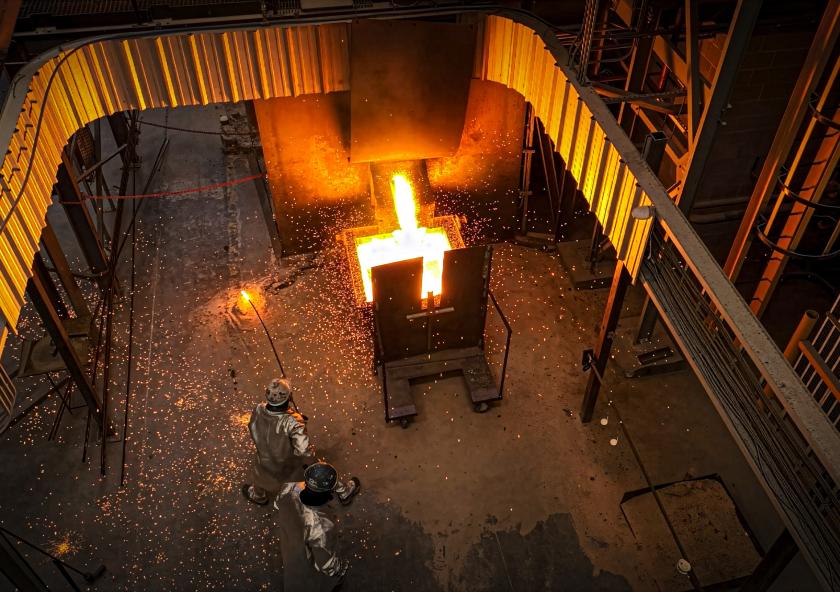
Since late 2024, Hertha has been operating a 1-tonne-per-day pilot plant at its first production facility outside Houston, Texas. The company calls it the world’s largest demonstration of a single-step steelmaking process. This year, the company will begin construction of a plant that will be able to produce 10,000 tons of steel each year. That plant, which Hertha expects to reach full production capacity at the end 2027, will also produce high-purity iron for the magnet industry, helping America onshore another critical material.
“By importing so much of our pig iron and steel, we are completely reliant on global trade mechanisms and geopolitics remaining the way they are today for us to continue making the materials that are critical for our infrastructure, our defense systems, and our energy systems,” Meroueh says. “Steel is the most foundational material to our society. It is simply irreplaceable.”
Streamlining steelmaking
Meroueh earned her master’s degree in the lab of Gang Chen, MIT’s Carl Richard Soderberg Professor of Power Engineering. As a MIT Energy Initiative Energy Scholar, she studied thermal energy storage and the fundamental physics of heat transfer, eventually getting her first taste of entrepreneurship when she explored commercializing some of that research. Meroueh received a grant from the MIT Sandbox Innovation Fund and considers Executive Director Jinane Abounadi a close mentor today.
The experience taught Meroueh a lot about startups, but she ultimately decided to stay at MIT to pursue her PhD in metallurgy and hydrogen production in the lab of Douglas Hart, MIT professor of mechanical engineering. After earning her PhD in 2020, she was recruited to lead a hydrogen production startup for a year and a half.
“After that experience, I was looking at all of the hard-to-abate, high-emissions sectors of the economy to find the one receiving the least attention,” Meroueh says. “I stumbled onto steel and fell in love.”
Meroueh became an Innovators Fellow at the climate and energy startup investment firm Breakthrough Energy and officially founded Hertha Metals in 2022.
The company is named after Hertha Ayrton, a 19th-century physicist and inventor who advanced our understanding of electric arcs, which the company uses in its furnaces.
Globally, most steel today is made by combining iron ore with coke (from coal) and limestone in a blast furnace to make molten iron. That “pig iron” is then sent to another furnace to burn off excess carbon and impurities. Alloying elements are then added, and the steel is sent for casting and finishing, requiring additional machinery.
The U.S. makes most of its steel from recycled scrap metal, but it still must import iron made from a blast furnace to reach useful grades of steel.
“The United States has a massive need to make steel from iron ore, not just scrap, so we can stop relying on importing so much,” Meroueh explains. “We only have about 11 operational blast furnaces in the U.S., so we end up importing about 90 percent of the pig iron needed to feed into domestic scrap steel furnaces.”
To solve the problem, Meroueh leverages a fuel America has in abundance: natural gas. Hertha’s system uses natural gas (the process also works with hydrogen) to reduce iron ore while using electricity to melt it in a single step. She says the closest competing process requires scarce and expensive pelletized, high-grade iron ore and multiple furnaces to produce liquid steel. Meroueh’s process uses iron ore of any format or grade, producing refined liquid steel in a single furnace, cutting both cost and emissions.
“Many reactions that were previously run sequentially though a conventional steelmaking process are now occurring simultaneously, within a single furnace,” Meroueh explains. “We’re melting, we’re reducing, and we’re carburizing the steel to the exact amount we need. What exits our furnace is a refined molten steel. We can process any grade and format of iron ore because everything is occurring in the molten phase. It doesn’t matter whether the ore came in as a pellet or clumps and fines out of the ground.”
Meroueh says the company’s biggest innovation is performing the gaseous reduction when the iron oxide is a molten liquid using proprietary gas technologies.
“All of the conventional steelmaking technologies perform reduction while the iron ore is in a solid state, and they use gas — whether that’s combusted coke or natural gas — to perform that reduction,” Meroueh says. “We saw the inefficiency in doing that and how it restricted the grade and form of usable iron ore, because at the end of the day you have to melt the ore anyway.”
Hertha’s system is modular and uses standard off-gas handling equipment, steam turbines, and heat exchangers. It also recycles natural gas to regenerate electricity from the hot off-gas leaving the furnace.
“Our steel mill has its own little power plant attached that leads to 35 percent recovery in energy and minimizes grid power demand in an age in which we are competing with data centers,” Meroueh says.
Onshoring critical materials
Today’s steel mills are the result of enormous investments and are designed to run for at least 50 years. Hertha Metals doesn’t envision replacing those entirely — at least not anytime soon.
“You’re not just going to shut off a steel mill in the middle of its life,” Meroueh says. “Sure, you can build new steel mills, but we really want to be able to displace the blast furnace and the basic oxygen furnace while still utilizing all the mill’s downstream equipment.”
The company’s Houston plant began producing one ton of steel per day just two years after Hertha’s founding and less than one year after Meroueh opened up Hertha’s headquarters. She calls it an important first step.
“This is the largest-scale demonstration of a single-step steelmaking company,” Meroueh says. “It’s a true breakthrough in terms of scalability, pace of progress, and capital efficiency.”
The company’s next plant, which will be capable of producing 10,000 tons of steel each year, will also be producing high-purity iron for permanent magnets, which are used in electric motors, robotics, consumer electronics, aerospace and military hardware.
“It’s insane that we don’t make rare earth magnets domestically,” Meroueh says. “It’s insane that any country doesn’t make their own rare earth magnets. Most rare earth magnets are permanent magnets, so neodymium magnets. What’s interesting is that by weight, 70 percent of that magnet is not a rare earth, it’s high-purity iron. America doesn’t currently make any high-purity iron, but Hertha has already made it in our pilot plant.”
Hertha plans to quickly scale up its production of high-purity iron so that, by 2030, it will be able to meet about a quarter of total projected demand for magnets in the U.S.
After that, the company plans to run a full-scale commercial steel plant in partnership with a steel manufacturer in America. Meroueh says that plant, which will be able to produce around half a million tons of steel each year, should be operational by 2030.
“We are eager to partner with today’s steel producers so that we can collectively leverage the existing infrastructure alongside Hertha’s innovation,” Meroueh says. “That includes the $1.5 billion of capital downstream of a melt shop that Hertha’s process can integrate into. The melt shop is the ore-to-liquid steel portion of the steel mill. That’s just the start. It’s a smaller scale than a conventional plant in which we still economically out compete traditional production processes. Then we’re going to scale to 2 million tons per year once we build up our balance sheet.”