



News
Exploring how plants thrive in a changing environment
Associate Professor David Des Marais studies how plants interact with their surroundings and adapt over time.
MIT News |
The Sierra Nevada mountain range in California is as stunning as it is diverse, with storms from the Pacific Ocean dumping rain and snow on the range’s western slopes while arid conditions mark much of its eastern face. David Des Marais, MIT’s Amgen Career Development Associate Professor, knows the mountains well. His childhood in San Francisco was filled with hiking and camping excursions throughout the range.
At some point during those trips, he started wondering about one of the few constants of the landscape: the presence of plants. How were plants able to thrive in all those conditions? He turned the question into a career.
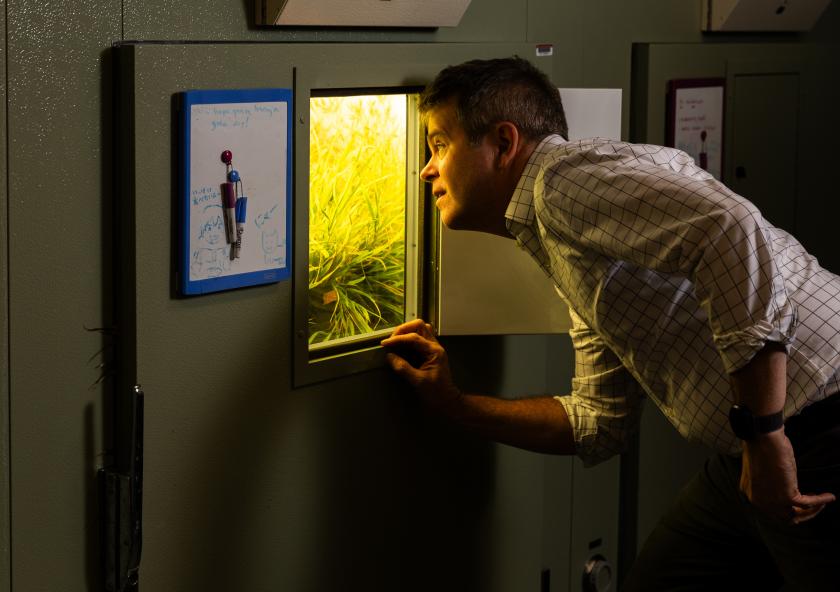
Des Marais, who directs the Parsons Laboratory in the Department of Civil and Environmental Engineering, studies how plants interact with their environment. The research spans molecules and mountain ranges, exploring everything from how individual genes change a plant’s ability to grow to how climate change will impact populations of red oak trees across the eastern U.S. His work also considers how evolutionary forces act on plants to change populations over time.
Plants are central to his lab, but Des Marais sees them as a window into all living things. He’s even quick to credit the health of his houseplants and garden to his wife, an evolutionary biologist at Harvard University.
“Understanding why life is so diverse is fascinating to me,” Des Marais says. “Understanding how different organisms, from bacteria to dinosaurs, have figured out how to interact with their challenging environment and optimize their fitness is inherently interesting. Why plants in particular? As a geneticist and a physiologist, plants are compelling experimental systems. If I have a theory about gene X causing function Y, I can go into the lab and delete gene X from this species and put it into that species and test function directly. It’s a powerful approach.”
Des Marais does not spend all his days in a lab. In addition to directing the Parsons Laboratory, he teaches four classes at MIT and has two sons who are active in baseball and theater. He welcomes these responsibilities.
At MIT especially, he embraces service.
“The only reason MIT works is because there are people willing to sacrifice some of their research to keep the place running,” Des Marais says. “One of the things I like about academia is that there’s sort of an institutional memory, and you try to honor the legacy of where you’ve been while you shape the future.”
From California to MIT
Des Marais grew up near Stanford University as well as near facilities for NASA and the U.S. Geological Survey, which meant there were always plenty of scientists and engineers around. His mother was a teacher, and his father was a geochemist with a knack for pointing out that the landscape around them was the result of geological processes dating back millions of years — a habit Des Marais admits he didn’t like at the time but that, in hindsight, influenced his thinking.
“I’m pretty sure that got into my brain, especially the idea that what looks static often comes about because of processes, and we can study those processes,” he says.
Des Marais studied integrative biology as an undergraduate at the University of California at Berkeley. He completed his PhD at Duke University around plant genetics.
“There’s a whole series of outdoor events, from the Boy Scouts through college, that made me start to think about the challenges that plants face living in these stressful environments,” he says. “That drove me to plant science and environmental science.”
In a long postdoc at the University of Texas at Austin, Des Marais learned to conduct experiments teasing out the effect of specific genes as he studied how they changed a model plant’s relationship with water.
Des Marais came to Boston primarily for personal reasons: He and his wife, who was also a postdoc at UT Austin, entered the job market at the same time. After some awkward moments competing for the same jobs, his wife landed a tenure-track position at Harvard University. Shortly after, he joined Harvard as a staff scientist.
In 2017, Des Marais discovered MIT’s Department of Civil and Environmental Engineering was hiring a plant ecologist.
“I don’t even think of myself as a plant ecologist, but I applied on a whim and they were interested,” Des Marais says. “I do a lot around plant water relations, and I joke that there are all these hydrologists in the department who study how water moves through the soil and into the atmosphere through these magical pipes. The magical pipes are plants, which play an important role in the water cycle. I realized a ton of people at MIT were studying that phenomenon at regional or global scales, but no one really studied how or why plants move water in the first place.”
Today Des Marais’ lab work can be broken into two broad categories. The first is centered around how plants function, including their relationship with environmental factors like water, temperature, and nutrients. Des Marais says some of his most impactful studies link specific molecules to how a plant functions in a given ecosystem.
The second centers around fundamental questions in plant evolution, what Des Marais describes as how plants “make decisions” about when to grow, reproduce, germinate, and more.
One current research project looks at how climate change will impact red oak trees, an important species and carbon sink. He is also examining climate change’s impact on plants that are important for food systems.
“We know that climate change is impacting plant function, and it’s impacting plant nutrition, and that impacts human nutrition,” Des Marais says. “Climate change is going to affect where we can grow which plants efficiently and how we can get them where they need to be eaten. All that stuff is critically important for humans.”
Understanding plants for the planet
Des Marais says it’s been fascinating working with experts in environmental chemistry and fluid mechanics as part of the Parsons Laboratory. He sees his role as director as being primarily about fostering community.
“The students are great,” Des Marais says. “It’s a funky old building, but we all work well together. We try to make sure everyone feels comfortable and welcome in the space.”
Even if he can’t take credit for his houseplants, Des Marais appreciates the vital role plants play for the planet.
“Plants are the foundation of the food chain, and there’s no way to get around that,” Des Marais says. “The efficiency of plant photosynthesis directly impacts our nutrition, and it impacts what we can feed the animals that we eat. It affects carbon cycling and water cycling — put simply, plant biology matters.”