



News
Climate change may produce “fast-food” phytoplankton
With warmer ocean temperatures, the composition of marine plankton could shift from protein-rich to carb-heavy, a new study suggests.
MIT News |
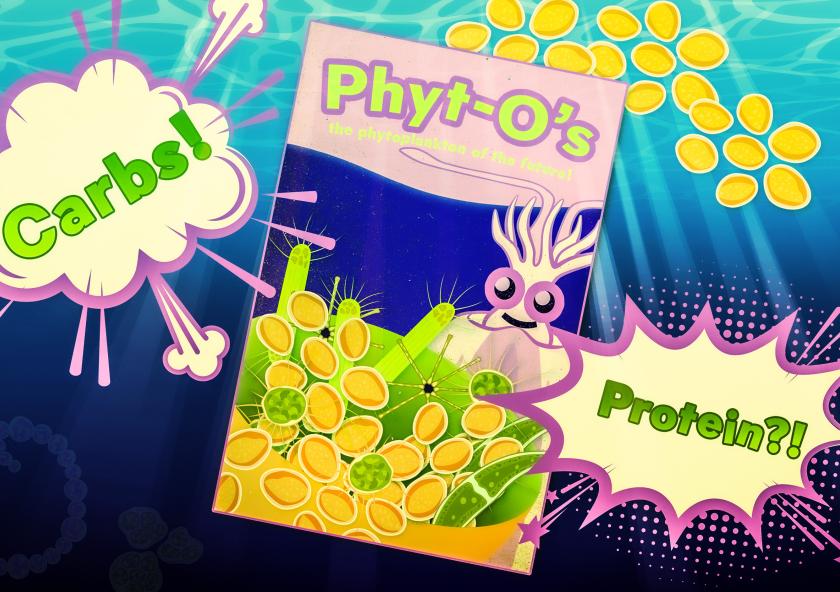
We are what we eat. And in the ocean, most life-forms source their food from phytoplankton. These microscopic, plant-like algae are the primary food source for krill, sea snails, some small fish, and jellyfish, which in turn feed larger marine animals that are prey for the ocean’s top predators, including humans.
Now MIT scientists are finding that phytoplankton's composition, and the basic diet of the ocean, will shift significantly with climate change.
In an open-access study appearing today in the journal Nature Climate Change, the team reports that as sea surface temperatures rise over the next century, phytoplankton in polar regions will adapt to be less rich in proteins, heavier in carbohydrates, and lower in nutrients overall.
The conclusions are based on results from the team’s new model, which simulates the composition of phytoplankton in response to changes in ocean temperature, circulation, and sea ice coverage. In a scenario in which humans continue to emit greenhouse gases through the year 2100, the team found that changing ocean conditions, particularly in the polar regions, will shift phytoplankton’s balance of proteins to carbohydrates and lipids by approximately 20 percent. The researchers analyzed observations from the past several decades, and already have found a signature of this change in the real world.
“We’re moving in the poles toward a sort of fast-food ocean,” says lead author and MIT postdoc Shlomit Sharoni. “Based on this prediction, the nutritional composition of the surface ocean will look very different by the end of the century.”
The study’s MIT co-authors are Mick Follows, Stephanie Dutkiewicz, and Oliver Jahn; along with Keisuke Inomura of the University of Rhode Island; Zoe Finkel, Andrew Irwin, and Mohammad Amirian of Dalhousie University in Halifax, Canada; and Erwan Monier of the University of California at Davis.
Nutritional information
Phytoplankton drift through the upper, sun-lit layers of the ocean. Like plants on land, the marine microalgae are photosynthetic. Their growth depends on light from the sun, carbon dioxide from the atmosphere, and nutrients such as nitrogen and iron that well up from the deep ocean.
When studying how phytoplankton will respond to climate change, scientists have primarily focused on how rising ocean temperatures will affect phytoplankton populations. Whether and how the plankton’s composition will change is less well-understood.
“There’s been an awareness that the nutritional value of phytoplankton can shift with climate change,” says Sharoni, “But there has been very little work in directly addressing that question.”
She and her colleagues set out to understand how ocean conditions influence phytoplankton macromolecular composition. Macromolecules are large molecules that are essential for life. The main types of macromolecules include proteins, lipids, carbohydrates, and nucleic acids (the building blocks of DNA and RNA). Every form of life, including phytoplankton, is composed of a balance of macromolecules that helps it to survive in its particular environment.
“Nearly all the material in a living organism is in these broad molecular forms, each having a particular physiological function, depending on the circumstances that the organism finds itself in,” says Follows, a professor in the Department of Earth, Atmospheric and Planetary Sciences.
An unbalanced diet
In their new study, the researchers first looked at how today’s ocean conditions influence phytoplankton’s macromolecular composition. The team used data from lab experiments carried out by their collaborators at Dalhousie. These experiments revealed ways in which phytoplankton’s balance of macromolecules, such as proteins to carbohydrates, shifted in response to changes in water temperature and the availability of light and nutrients.
With these lab-based data, the group developed a quantitative model that simulates how plankton in the lab would readjust its balance of proteins to carbohydrates under different light and nutrient conditions. Sharoni and Inomura then paired this new model with an established model of ocean circulation and dynamics developed previously at MIT. With this modeling combination, they simulated how phytoplankton composition shifts in response to ocean conditions in different parts of the world and under different climate scenarios.
The team first modeled today’s current climate conditions. Consistent with observations, their model predicts that that a little more than half of the average phytoplankton cell today is composed of proteins. The rest is a mix of carbohydrates and lipids.
Interestingly, in polar regions, phytoplankton are slightly more protein-rich. At the poles, the cover of sea ice limits the amount of sunlight phytoplankton can absorb. The researchers surmise that phytoplankton may have adapted by making more light-harvesting proteins to help the organisms efficiently absorb the weak sunlight.
However, when they modeled a future climate change scenario, the team found a significant shift in phytoplankton composition. They simulated a scenario in which humans continue to emit greenhouse gases through the year 2100. In this scenario, the ocean sea surface temperatures will rise by 3 degrees Celsius, substantially reducing sea ice coverage. Warmer temperatures will also limit the ocean’s circulation, as well as the amount of nutrients that can circulate up from the deep ocean.
Under these conditions, the model predicts that the population of phytoplankton growth in polar regions will increase significantly, consistent with earlier studies. Uniquely, this model predicts that phytoplankton in polar regions will shift from a protein-rich to a carb- and lipid-heavy composition. They found that plankton will not need as much light-harvesting protein, since less sea ice will make sunlight more easily available for the organisms to absorb. Total protein levels in these polar phytoplankton will decline by up to 30 percent, with a corresponding increase in the contribution of carbs and lipids.
It’s unclear what impact a larger population of carb- and lipid-heavy phytoplankton may have on the rest of the marine food web. While some organisms may be stressed by a reduction in protein, others that make lipid stores to survive through the winter might thrive.
The team also simulated phytoplankton in subtropical, higher-latitude regions. In these ocean areas, it’s expected that phytoplankton populations will decline by 50 percent. And the team’s modeling shows that their composition will also shift.
With warmer temperatures, the ocean’s circulation will slow down, limiting the amount of nutrients that can upwell from the deep ocean. In response, subtropical phytoplankton may have to find ways to live at deeper depths, to strike a balance between getting enough sunlight and nutrients. Under these conditions, the organisms will likely shift to a slightly more protein-rich composition, making use of the same photosynthetic proteins that their polar counterparts will require less of.
On balance, given the projected changes in phytoplankton populations with climate change, their average composition around the world will shift to a more carb-heavy, low-nutrient composition.
The researchers went a step further and found that their modeling agrees with available small set of actual phytoplankton field samples that other scientists previously collected from Arctic and Antarctic regions. These samples showed compositions of phytoplankton have become more carb- and lipid-heavy over the past few decades, as the team’s model predicts under climate warming.
“In these regions, you can already see climate change, because sea ice is already melting,” Sharoni explains. “And our model shows that proteins in polar plankton have been declining, while carbs and lipids are increasing.”
“It turns out that climate change is accelerated in the Arctic, and we have data showing that the composition of phytoplankton has already responded,” Follows adds. “The main message is: The caloric content at the base of the marine food web is already changing. And it’s not a clear story as to how this change will transmit through the food web.”
This work was supported, in part, by the Simons Foundation.