



News
Carbon removal project supports Maine’s blue economy, broader marine health
A chemical-free approach to balancing ocean acidity protects marine life and could dramatically impact the global aquaculture market.
MIT News |
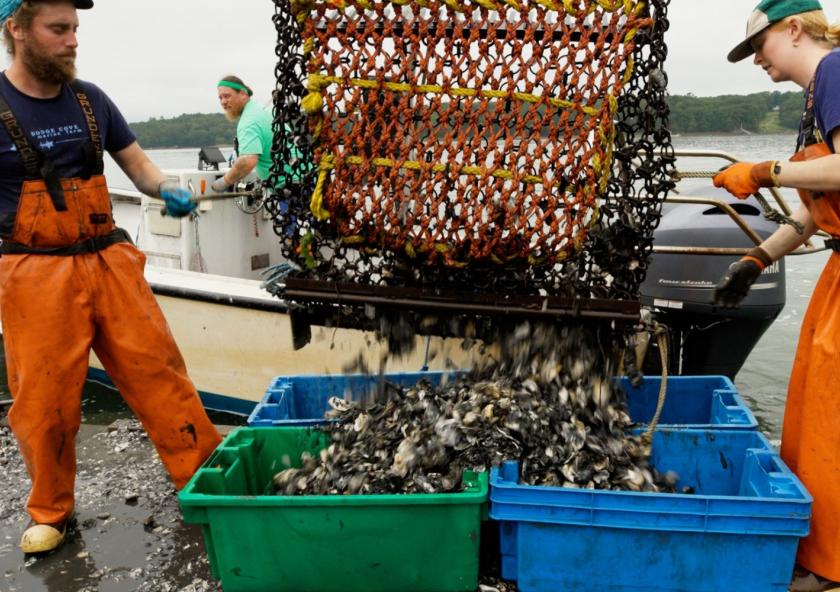
Oceans absorb roughly 25 to 30 percent of the carbon dioxide (CO2) that is released into the atmosphere. When this CO2 dissolves in seawater, it forms carbonic acid, making the water more acidic and altering its chemistry. Elevated levels of acidity are harmful to marine life like corals, oysters, and certain plankton that rely on calcium carbonate to build shells and skeletons.
“As the oceans absorb more CO2, the chemistry shifts — increasing bicarbonate while reducing carbonate ion availability — which means shellfish have less carbonate to form shells,” explains Kripa Varanasi, professor of mechanical engineering at MIT. “These changes can propagate through marine ecosystems, affecting organism health and, over time, broader food webs.”
Loss of shellfish can lead to water quality decline, coastal erosion, and other ecosystem disruptions, including significant economic consequences for coastal communities. “The U.S. has such an extensive coastline, and shellfish aquaculture is globally valued at roughly $60 billion,” says Varanasi. “With the right innovations, there is a substantial opportunity to expand domestic production.”
“One might think, ‘this [depletion] could happen in 100 years or something,’ but what we’re finding is that they are already affecting hatcheries and coastal systems today,” he adds. “Without intervention, these trends could significantly alter marine ecosystems and the coastal economies that rely on them over time.”
Varanasi and T. Alan Hatton, the Ralph Landau Professor of Chemical Engineering, Post-Tenure, at MIT, have been collaborating for years to develop methods for removing carbon dioxide from seawater and turn acidic water back to alkaline. In recent years, they’ve partnered with researchers at the University of Maine Darling Marine Center to deploy the method in hatcheries.
“The way we farm oysters, we spawn them in special tanks and rear them through about a two-week larval period … until they’re big enough so that they can be transferred out into the river as the water warms up,” explains Bill Mook, founder of Mook Sea Farm. Around 2009, he noticed problems with production of early-stage larvae. “It was a catastrophe. We lost several hundred thousand dollars’ worth of production,” he says.
Ultimately, the problem was identified as the low pH of the water that was being brought in: The water was too acidic. The farm’s initial strategy, a common practice in oyster farming, was to buffer the water by adding sodium bicarbonate. The new approach avoids the use of chemicals or minerals.
“A lot of researchers are studying direct air capture, but very few are working in the ocean-capture space,” explains Hatton. “Our approach is to use electricity, in an electrochemical manner, rather than add chemicals to manipulate the solution pH.”
The method uses reactive electrodes to release protons into seawater that is collected and fed into the cells, driving the release of the dissolved carbon dioxide from the water. The cyclic process acidifies the water to convert dissolved inorganic bicarbonates to molecular carbon dioxide, which is collected as a gas under vacuum. The water is then fed to a second set of cells with a reversed voltage to recover the protons and turn the acidic water back to alkaline before releasing it back to the sea.
Maine’s Damariscotta River Estuary, where Mook farms is located, provides about 70 percent of the state’s oyster crop. Damian Brady, a professor of oceanography based at the University of Maine and key collaborator on the project, says the Damariscotta community has “grown into an oyster-producing powerhouse … [that is] not only part of the economy, but part of the culture.” He adds, “there’s actually a huge amount that we could learn if we couple the engineering at MIT with the aquaculture science here at the University of Maine.”
“The scientific underpinning of our hypothesis was that these bivalve shellfish, including oysters, need calcium carbonate in order to form their shells,” says Simon Rufer PhD ’25, a former student in Varanasi’s lab and now CEO and co-founder of CoFlo Medical. “By alkalizing the water, we actually make it easier for the oysters to form and maintain their shells.”
In trials conducted by the team, results first showed that the approach is biocompatible and doesn't kill the larvae, and later showed that the oysters treated by MIT's buffer approach did better than mineral or chemical approaches. Importantly, Hatton also notes, the process creates no waste products. Ocean water goes in, CO2 comes out. This captured CO2 can potentially be used for other applications, including to grow algae to be used as food for shellfish.
Varanasi and Hatton first introduced their approach in 2023. Their most recent paper, “Thermodynamics of Electrochemical Marine Inorganic Carbon Removal,” which was published last year in journal Environmental Science & Technology, outlines the overall thermodynamics of the process and presents a design tool to compare different carbon removal processes. The team received a “plus-up award” from ARPA-E to collaborate with University of Maine and further develop and scale the technology for application in aquaculture environments.
Brady says the project represents another avenue for aquaculture to contribute to climate change mitigation and adaptation. “It pushes a new technology for removing carbon dioxide from ocean environments forward simultaneously,” says Brady. “If they can be coupled, aquaculture and carbon dioxide removal improve each other’s bottom line."
Through the collaboration, the team is improving the robustness of the cells and learning about their function in real ocean environments. The project aims to scale up the technology, and to have significant impact on climate and the environment, but it includes another big focus.
“It’s also about jobs,” says Varanasi. “It’s about supporting the local economy and coastal communities who rely on aquaculture for their livelihood. We could usher in a whole new resilient blue economy. We think that this is only the beginning. What we have developed can really be scaled.”
Mook says the work is very much an applied science, “[and] because it’s applied science, it means that we benefit hugely from being connected and plugged into academic institutions that are doing research very relevant to our livelihoods. Without science, we don’t have a prayer of continuing this industry.”