



Thought Leadership
AI to Reduce Building Energy Use: Pilot Program Update and Next Steps

Photo by Ken Richardson, with AI-generated overlays.
In 2023, MIT launched a set of pilot programs to explore how artificial intelligence (AI) could help reduce energy use and emissions across campus buildings. As highlighted in MIT News, the goal was not just to develop, test, and pilot new AI tools, but to integrate them into a robust, data-rich building infrastructure that MIT has been strengthening for nearly a decade.
Today, the pilot program is demonstrating measurable results and the project team is preparing for expansion.
Eight Years of Foundational Work
As Fran Selvaggio, MIT Department of Facilities Senior Building Management Systems Engineer, recently emphasized at the Smart Data for Energy Summit, the Institute has invested heavily in foundational improvements, including:
-
Substantial building automation system (BAS) upgrades
-
Standardization and modernization of controls
-
Extension of fault detection and diagnostics across campus buildings
-
Improved data integration and analytics capabilities
This groundwork enables AI tools to operate more effectively and be applied on more buildings. Rather than replacing traditional energy efficiency building control system strategies, AI builds on them by optimizing how and when buildings need heating or cooling energy taking into account class schedules, room occupancy, weather, and local electricity grid conditions.
A Multi-Level Approach to Energy Reduction
MIT’s approach to reducing building energy use includes three layers of optimization. The first two are established building controls and operational strategies, while the third introduces machine learning to further enhance performance. The impact of these approaches varies depending on building type, such as offices, classrooms, or labs, as well as the building control system in use. The three layers include:
-
Smart Scheduling
Integrates class schedules directly into determining heating and cooling temperature setpoints, which are the target temperatures that the building’s heating, ventilation, and air conditioning system is programmed to maintain in a specific space. This seeks to ensure that classrooms are conditioned only when needed. -
Smart Set Points
Expands the temperature setpoint range in a space within acceptable comfort levels, particularly during low-occupancy periods. -
Building-Level AI Optimization
Uses machine learning models that account for weather forecasts, occupancy patterns, operating schedules, and local electricity grid conditions to dynamically optimize building performance.
This multi-level approach ensures that the right heating or cooling solution is applied in the right context to maximize efficiency without compromising occupant comfort.
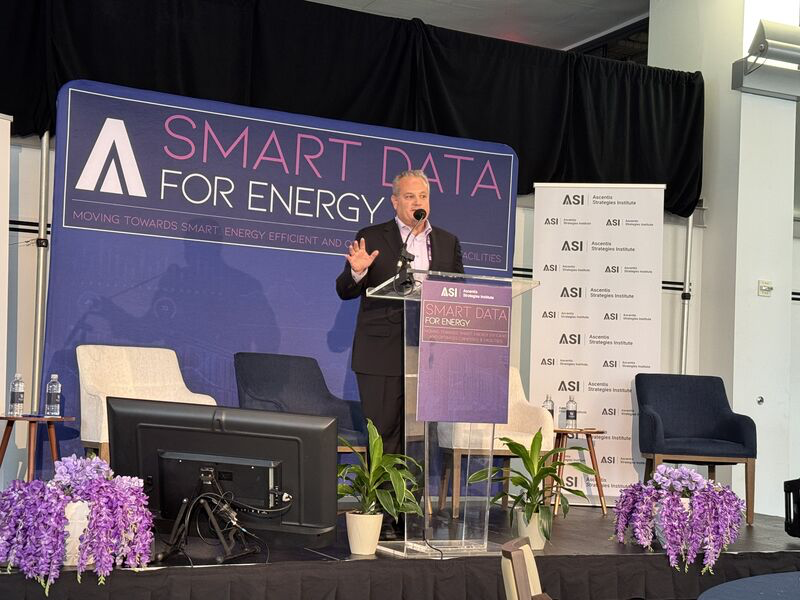
Fran Selvaggio (MIT Department of Facilities Senior Building Management Systems Engineer) presented on MIT’s multi-level AI strategy to reduce building energy use, highlighting the foundational building automation upgrades completed over the past eight years. (Photo by Alex Grace, Chief Commercial Officer at Clockworks Analytics.)
Early Results: Measurable Energy Savings
Initial pilot results on campus are promising:
-
Up to 40% annual energy savings in Building 66 classrooms with the AI-assisted controls through Smart Scheduling combined with improved controls and treatment of incoming air.
-
5–30% summer energy savings in Building NW23 from Smart Set Points alone.
-
10–70% summer energy savings in NW23 through Building-Level AI optimization that accounts for weather, occupancy, scheduling, and grid conditions.
These results are promising and demonstrate that combining traditional efficiency improvements with AI-driven optimization has the potential to deliver substantial reductions in energy use, particularly during high-demand summer periods.
Scaling Up in 2026
With strong, early results, the team is preparing to expand beyond the pilot in the upcoming academic year.
In classrooms, the next step is completing integration with the Registrar’s electronic scheduling tool so building heating and cooling systems can automatically respond to live scheduling data. The goal is to scale Smart Scheduling to approximately 160 classrooms, increasing the impact of occupancy-based control across campus.
The program is also expanding to offices and whole-building approaches in Buildings E17, E18, E19, E60 and 11, where building management systems are compatible with AI-based optimization. These deployments will test performance across a range of building types.
In parallel, the team will assess the cost-effectiveness of integrating room occupancy sensors with the AI-enabled controls, along with an occupant feedback tool to gauge occupant comfort. Working with Campus Utility Plant staff, the group will also quantify associated carbon reductions to better understand the program’s contribution to MIT’s climate goals.
A Collaborative Effort
A defining feature of this pilot project has been the depth of collaboration across MIT research, operations, and industry partners. The team includes:
-
MIT Department of Architecture Building Technology Program: Les Norford, Sicheng Zhan
-
MIT Climate & Sustainability Consortium: Jeremy Gregory
-
MIT Schwarzman College of Computing Laboratory for Information and Decision Systems Audun Botterud, You Lin
-
MIT Office of Sustainability: Steve Lanou
-
MIT Vice President for Campus Services and Stewardship: Joe Higgins
-
MIT Department of Facilities: Fran Selvaggio
-
Schneider Electric: Michael Kearns, Tyler Perron
This partnership drives solutions that are technically rigorous, operationally feasible, and aligned with campus sustainability priorities.
As the program scales up, the focus will shift from pilots to broader implementation and analysis of long-term energy and carbon impacts. By combining strong building infrastructure with advanced analytics, MIT is advancing a practical and data-driven approach to reducing emissions from existing buildings.
Looking Ahead
As the program expands to additional classrooms and whole-building approaches, the focus will move from proof-of-concept to scalable implementation.
Some key questions that will be addressed in the coming year include:
-
How cost-effective is the integration of occupancy sensors and AI-enabled controls across different building types?
-
How do automated control strategies influence occupant comfort and space use?
-
What could be the cumulative carbon reductions at campus scale?
By combining building automation upgrades, operational expertise, and advanced analytics, MIT is developing a practical model for reducing emissions from existing buildings. The next phase will strengthen the feedback loop between data, controls, and occupant needs to anticipate demand, cut waste, and deliver comfort with less energy. Insights from this work will guide decisions about broader campus deployment.